
Published: January 28, 2026
Author: TryOnMe Editorial Team
Reading time: 6 minutes
Category: Open Source · WordPress · AI · E-commerce
TryOnMe: An Open-Source WordPress Plugin Built to Reduce Returns and Increase ROI
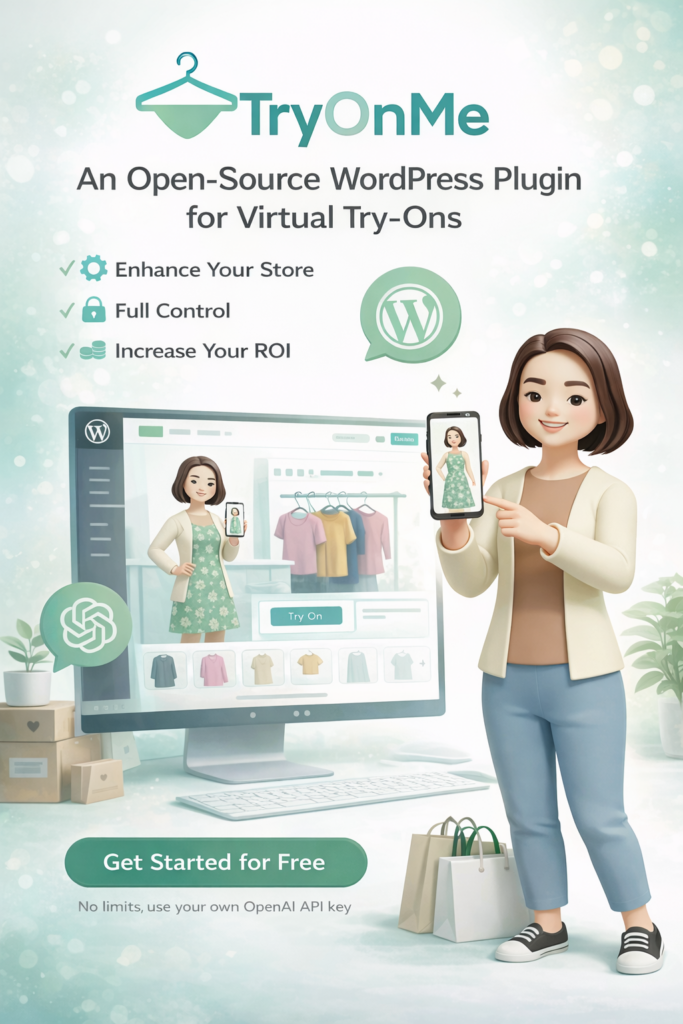
Open source by design. Transparent by principle. Built for the web.
E-commerce is evolving fast, but one problem remains stubbornly expensive: product returns. For merchants, returns drain margins. For customers, they break trust. For the web as a whole, they represent inefficiency at scale.
TryOnMe was created to address this problem at its root.
TryOnMe is an open-source WordPress plugin that leverages the OpenAI API to power intelligent, contextual virtual try-on and assistance experiences — while preserving full transparency, ownership, and flexibility for merchants and developers.
Our goal is clear: help online businesses reduce returns and increase return on investment, without locking anyone into proprietary systems.
Why TryOnMe Is Open Source
Open source is not an afterthought for TryOnMe — it is a foundational choice.
By making the plugin open source, we ensure that:
- Anyone can inspect and audit the code
- Developers can extend, fork, or adapt the plugin
- Agencies can build custom solutions for clients
- Merchants retain full control over their stack
There are no hidden layers, no black boxes, and no forced dependencies. If you use WordPress, you can use TryOnMe — on your own terms.
This openness builds trust not only with developers, but also with end users who increasingly care about transparency, data usage, and long-term sustainability.
How TryOnMe Works
TryOnMe integrates directly into WordPress and connects to OpenAI using your own API key.
This architecture means:
- No bundled AI usage fees
- No resale of API access
- No artificial feature tiers
You decide how TryOnMe is used, scaled, and customized. Costs remain predictable, measurable, and fully under your control.
From a technical standpoint, TryOnMe is designed to be:
- Modular
- Lightweight
- Compatible with modern WordPress workflows
From a business standpoint, it is designed to pay for itself by improving conversion quality, not just quantity.
Reducing Returns Starts Before Checkout
Most returns happen because expectations are misaligned. Size, fit, appearance, or usage don’t match what the customer imagined.
TryOnMe addresses this before the purchase happens by:
- Helping users visualize products more accurately
- Answering contextual questions in real time
- Reducing hesitation and uncertainty
- Increasing confidence at decision points
The result is not just fewer returns, but better purchases — which directly translates into higher lifetime value and stronger brand trust.
Built for the Community, Not Locked to a Platform
Because TryOnMe is open source:
- Developers can contribute improvements
- The community can audit security and performance
- Businesses can adapt it to niche use cases
- Innovation is shared, not siloed
We believe the best tools grow with their communities. TryOnMe is not a closed product — it is a shared foundation.
SEO, GEO, and the Future of Discoverability
Search is changing. Traditional SEO is no longer enough on its own.
Generative search engines, AI assistants, and answer-based discovery systems now prioritize:
- Clear structure
- Explicit intent
- Machine-readable content
- Trustworthy technical signals
TryOnMe’s editorial approach, documentation, and site structure are intentionally designed for:
- SEO (Search Engine Optimization)
- AEO (Answer Engine Optimization)
- GEO (Generative Engine Optimization)
This ensures that both humans and AI systems understand what TryOnMe does, how it works, and why it exists.
Our Long-Term Vision
TryOnMe will remain:
- Open source
- WordPress-native
- API-driven
- Community-first
We are not here to own your data, your users, or your infrastructure.
We are here to help the web sell better — and return less.
TryOnMe is free to use.
You bring your OpenAI API key.
You keep full control.
That’s not just our pricing model.
It’s our philosophy.